



Ich stimme der Verwendung von Cookies zu. Auch wenn ich diese Website weiter nutze, gilt dies als Zustimmung.

Bitte lesen und akzeptieren Sie die Datenschutzinformation und Cookie-Informationen, damit Sie unser Angebot weiter nutzen können. Natürlich können Sie diese Einwilligung jederzeit widerrufen.


Central Europe: Resilience weakens & Russia: Growth variability (Martin Ertl)

6 weitere Bilder
(mit historischen Bildtexten)

Industrial Production

Yields on Government Bonds

GDP growth

Construction status

RUB yield projection
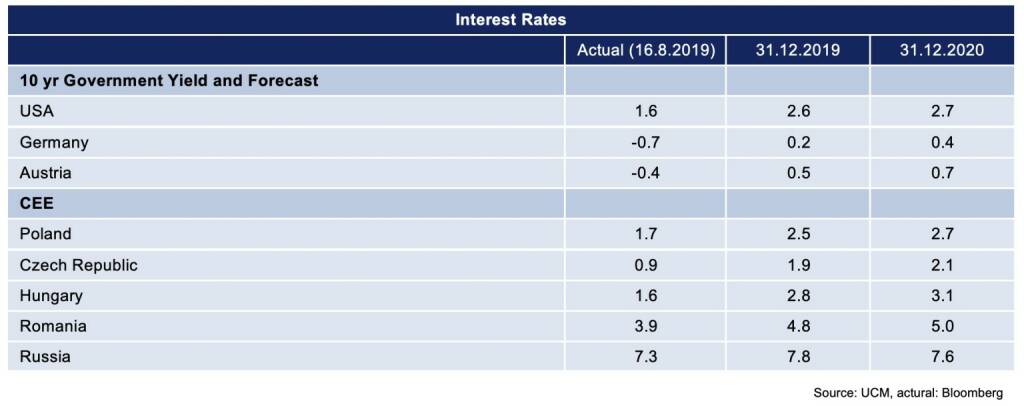
Interest Rates

Autor:
Martin Ertl

Chief Economist, UNIQA Capital Markets GmbH

>> Website


>> zur Startseite mit allen Blogs

19.08.2019, 8059 Zeichen

Central Europe: Resilience weakens

  • Economic growth continues at a slightly more moderate pace in Central Europe.
  • Recent industrial production figures might herald weakening resilience to the slowing Euro Area’s business cycle.
  • The dovish turn by the ECB has stopped monetary policy normalization in Central Europe.

    Economic growth momentum in Central Europe (CE) remains well above the Euro Area (EA), yet uncertainty about CE’s resilience to the EA’s business cycle slowdown rises. Last week’s release of gross domestic product (GDP) for the second quarter (Q2 19) showed growth at 1.1 % in Hungary, 0.8 % in Poland, 0.6 % in the Czech Republic and 0.4 % in Slovakia (quarter-on-quarter, seasonally adjusted). The Euro Area economy expanded at 0.2 % (q/q, sa) during the same period. Compared to previous quarters growth momentum has weakened in Poland and Slovakia while remaining rather stable in the Czech Republic and Hungary. Figure 1 shows quarterly GDP growth rates since 2016 as moving averages over 3 quarters. The Czech Republic was the first country where growth rates started to decline, followed by Slovakia and Poland, while, so far, no clear moderation is visible in Hungary.

The region’s resilience to the Euro Area’s slowing business cycle rests on its focus on domestic demand. Private consumption and investment activity have compensated for the deteriorating external environment. Nevertheless, the small open economies of the CE region continue to be heavily integrated into Euro Area and global value chains, particularly through Germany. Thus, the longer the business cycle weakness continues, the more likely it is that growth weakens in CE through affecting domestic demand, particularly investment as we have shown earlier [1].

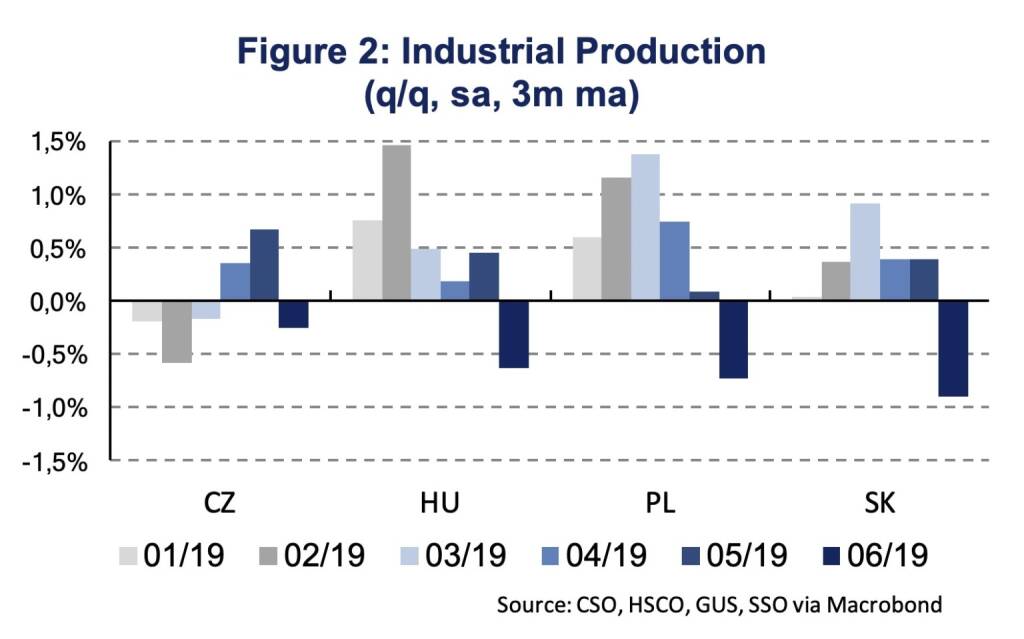
A potential indication of negative business cycle spillovers could be the most recent industrial production figures. In June industrial production declined in all CE-4 countries by more than 2 %, on a month-on-month seasonally adjusted basis (CZ: -2.8 %, HU: -2.7 %, PL: -2.0 %, SK: -2.3 %). The decline was most pronounced in the production of capital goods (-4.6 %, CE-4 average in June, m/m, sa), followed by intermediary goods (-2.5 %) and consumer goods (-0.5 %). As figure 2 shows, industrial production has deteriorated since the start of the year (3-month moving average, month-on-month growth rates). The business climate softened as leading sentiment indicators, like the Purchasing Manager Index (PMI) for the manufacturing sector, indicate. The index signals a contraction, index < 50, in the Czech Republic (43.1) and Poland (47.4), while signaling more favorable conditions in Hungary (51.3).

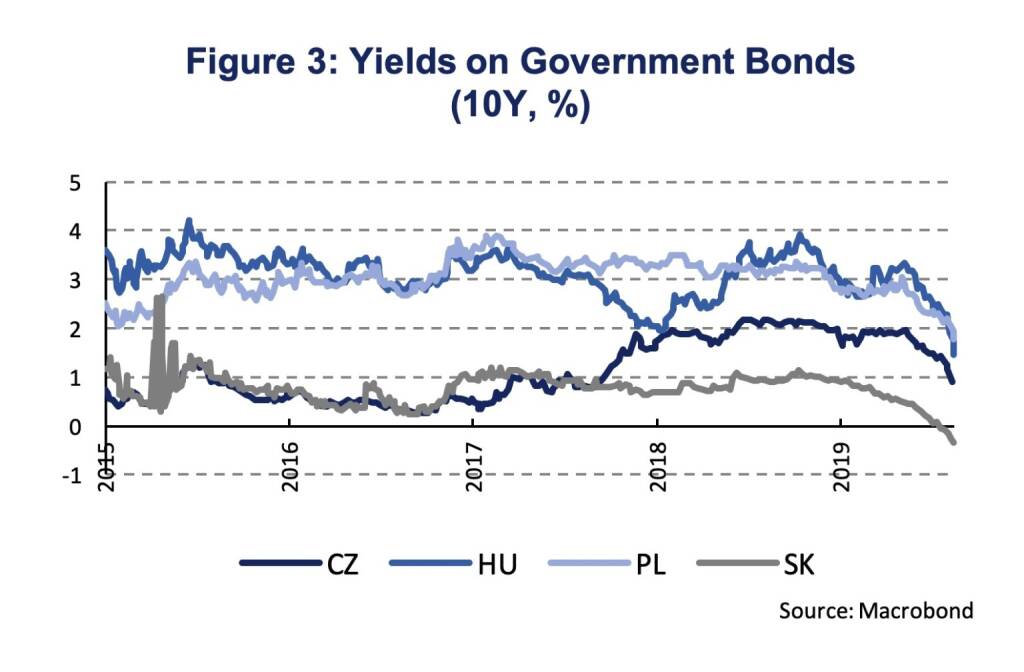
  Spillovers are not confined to the industrial sector. Global financial markets have seen a substantial compression of yields on debt securities. The CE region has not been an exception. Yields on government bonds with maturities of 10 years have declined by 120 basis points (bp), on average in CE 4, since the end of April 2019 (Figure 3). Yields declined by 1.7 %-age points in Hungary (3.3 % to 1.6 %), 1.1 %-age points in Poland (2.9 % to 1.8 %) and the Czech Republic (1.9 % to 0.9 %) and 0.9 %-age points in Slovakia (0.5 % to -0.3 %). Financial markets are expecting substantial monetary easing by leading central banks (Fed & ECB), which drives down global yields. As a consequence, investors allocate more funds into emerging markets on their search for yield. This has also brought an end to monetary policy normalization in Central Europe, where increases in central bank interest rates have become more unlikely. Depending on the extent of and ECB stimulus package, CE central banks   might even have to follow suit and ease monetary policy. A recent sensitivity analysis by the Czech National Bank (CNB) shows the possibility of two rate cuts (-40 bp) in 2020, if the ECB eases monetary policy significantly (CNB Inflation Report III/2019).

Russia: Growth variability

  • Short-term growth pick-up in Q2, yet the economy is set to continue moderate though stable growth. The ruble yield development is in line with the medium-term outlook for yields to converge towards more neutral levels. 

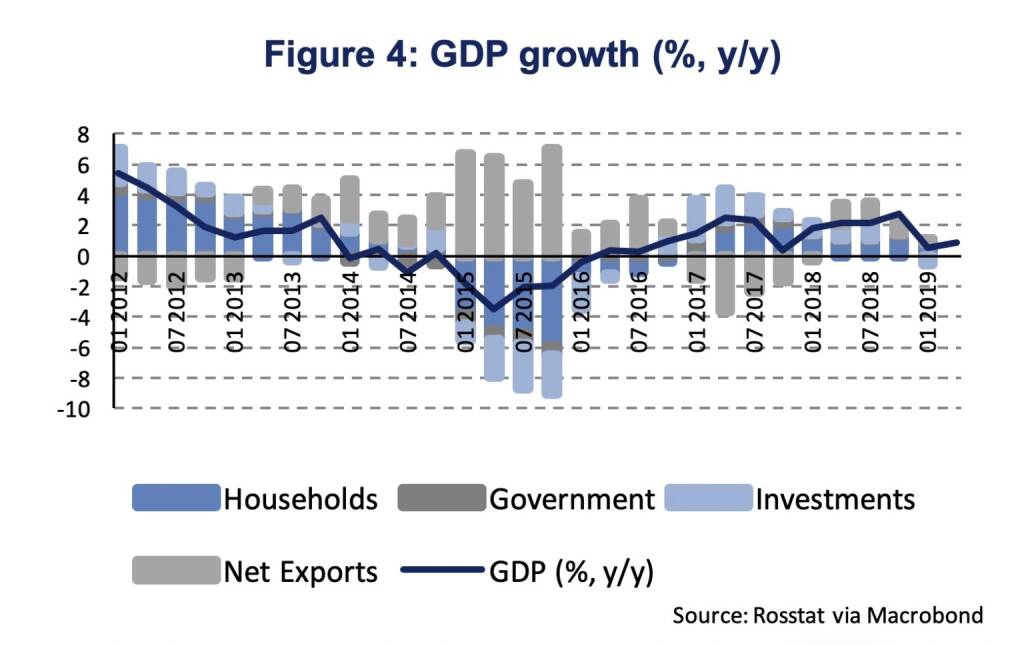
Russia’s economy surprised with a pick-up in growth during the second quarter as real GDP rose by 0.9 % compared to the correspond quarter in 2018 (Figure 4). In Q1, annual GDP growth had slowed to 0.5 % after a surge by year-end 2018 (+2.7 %). In seasonally-adjusted terms, we calculate that GDP increased by 0.6 % compared to the previous quarter after stagnating in Q1. Despite the acceleration the overall picture is likely to remain muted. 

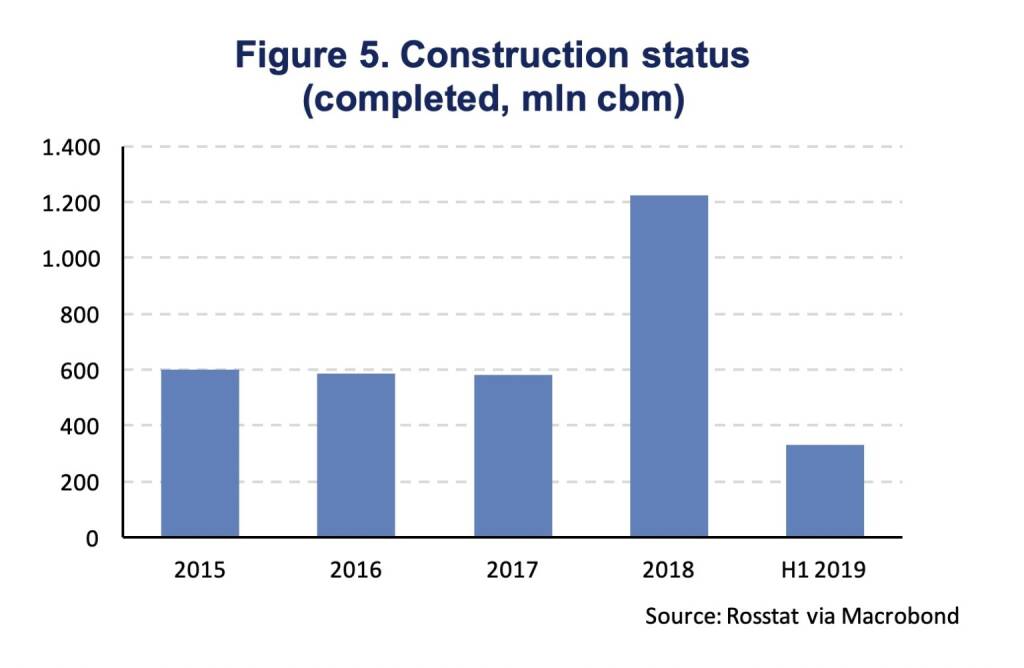
Q2 GDP expenditure details are not yet released. In Q1, growth in household consumption had slowed (+1.6 % y/y) but remained the main contributor to growth. Additionally, net exports have been contributing to GDP growth (both imports and exports dropping in Q1 but imports more so), while fixed investment fell by 2.6 % in Q1 2019 (as well as inventories). The development during the last three quarters hints at considerable variability in the data and we suggested that the construction sector is a source of variation (Figure 5). Completed construction was exceptionally high in Q4 2018 (570 mln cbm) but returned to more normal levels in Q1 and Q2 2019 (105 and 225 mln cbm). The implementation period of major national projects was shifted to the second half of the year, and, hence, successful completion could fuel construction and GDP in H2 2019 and 2020. The developments are in line with our own GDP growth forecast for this year (1.0 %) and 2020 (1.5 %). 

  Consumer expenditure has been driven by rising wages and credit growth. However, real wage growth was slow during recent months (on average 2.3 % annually during April to June) and significantly lower than last year (7 %). In light of this, real retail sales exhibit a slower expansion (+1.4 % y/y in June after 2.8 % in 2018). The unemployment rate remains fairly low (4.4 % in June after 4.8 % last year) although job growth is virtually absent in Russia. On the other side, bank lending to households continued at a double-digit, elevated rate (+22.4 % y/y in July) thereby supporting consumer spending.

The inflation rate declined to 4.6 % in July after a temporary increase above 5 % earlier in the year. The price declines are broad-based across categories with food & beverage (5.5 %), non-food (3.6 %) and services prices (3.3 %) exhibiting lower price increases than in early 2019. Especially, the food & beverage component had contributed to price increases in 2019 likely related to the VAT increase (from 18 to 20 %). Survey inflation expectations indicate no significant tendencies that agents expect higher inflation. Against the background of weak economic activity (the CBR projects 1-1.5 % % GDP growth for 2019 in the June Monetary Policy Report) and lowering inflation, the Central Bank of Russia (CBR) cut the key interest rate in June and July by 25 basis points each time to 7.25 % and even indicated the possibility of further key rate reduction in one of the upcoming meetings. The CBR also expects that inflation will return to its 4 % target and that monetary policy will become neutral during 2020.

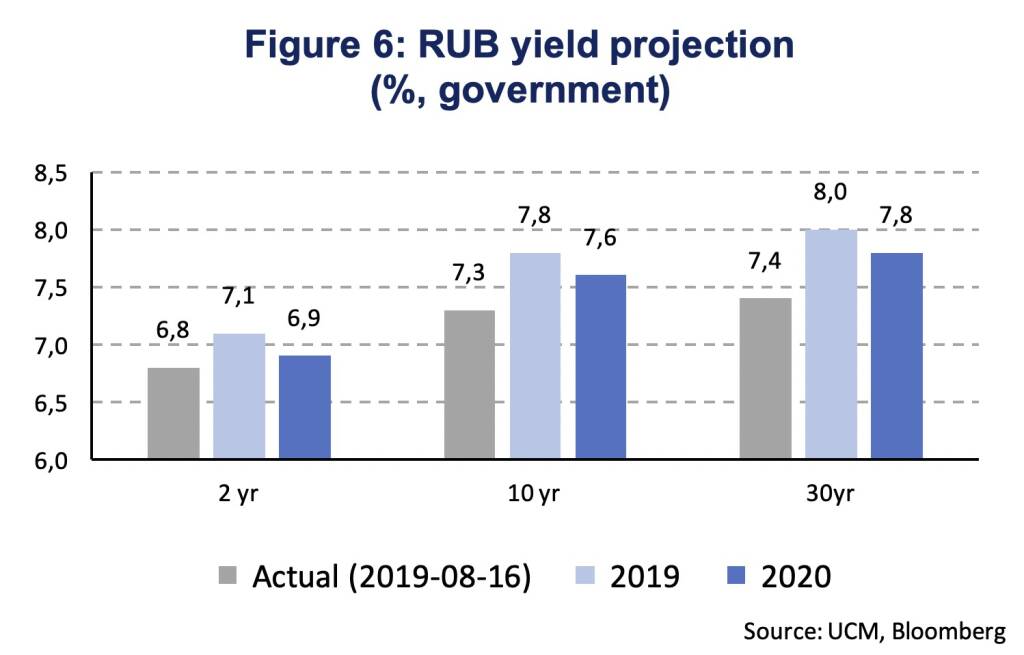
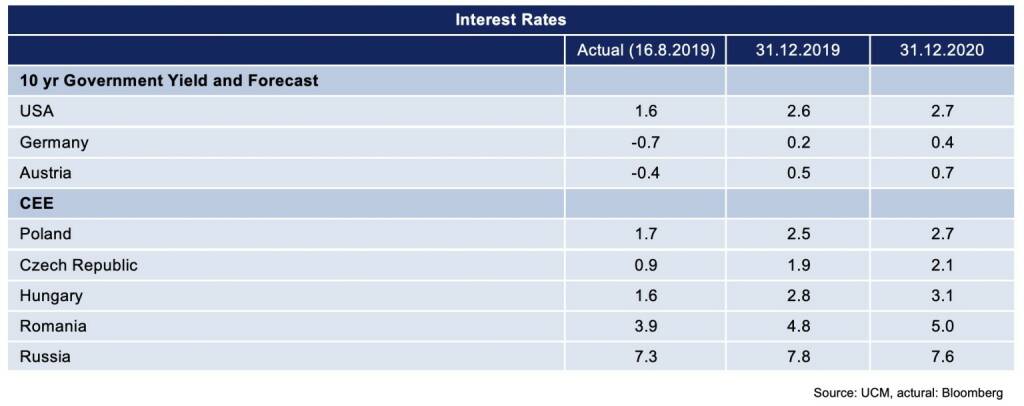
Among other factors, which include increased macroeconomic stability, monetary policy loosening has contributed to a significant decline in ruble yields (Figure 6). The reductions in the CBR key interest were in line with our outlook although – amid lower inflation – came with higher speed than assumed previously. We assume a longer-term, equilibrium real level of interest rates of around 4 % which is sustainable for the Russian economy, yet indications for an equilibrium rate are scarce for Russia. Based on our internal rating model, we project a stable medium-term development of the sovereign borrower credit position in spite of a low growth steady-state.

[1] CEE’s resilience to Euro Area’s growth slowdown, UNIQA Capital Markets Weekly, 18.2.2019.

Authors

Martin Ertl Franz Xaver Zobl

Chief Economist Economist

UNIQA Capital Markets GmbH UNIQA Capital Markets GmbH


(19.08.2019)

BSN Podcasts
Christian Drastil: Wiener Börse Plausch

Wiener Börse Party #1147: ATX zum Mai-Start etwas leichter, AT&S flirtet mit der Dreistelligkeit, auch Polytec erneut gesucht, Semperit klug


Bildnachweis

1. Growth Momentum

2. Industrial Production

3. Yields on Government Bonds

4. GDP growth

5. Construction status

6. RUB yield projection

7. Interest Rates

Aktien auf dem Radar:Mayr-Melnhof, Flughafen Wien, AT&S, Zumtobel, FACC, Lenzing, OMV, Polytec Group, Palfinger, Fabasoft, Rosgix, Bajaj Mobility AG, VIG, Bawag, Marinomed Biotech, Erste Group, Athos Immobilien, BTV AG, DO&CO, RBI, voestalpine, Wolftank-Adisa, Wiener Privatbank, Rosenbauer, Semperit, BKS Bank Stamm, Oberbank AG Stamm, Amag, CA Immo, EuroTeleSites AG, CPI Europe AG.


Random Partner

Agrana
Die Agrana Beteiligungs-AG ist ein Nahrungsmittel-Konzern mit Sitz in Wien. Agrana erzeugt Zucker, Stärke, sogenannte Fruchtzubereitungen und Fruchtsaftkonzentrate sowie Bioethanol. Das Unternehmen veredelt landwirtschaftliche Rohstoffe zu vielseitigen industriellen Produkten und beliefert sowohl lokale Produzenten als auch internationale Konzerne, speziell die Nahrungsmittelindustrie.

>> Besuchen Sie 55 weitere Partner auf boerse-social.com/partner

Industrial Production


Yields on Government Bonds


GDP growth


Construction status


RUB yield projection


Interest Rates


 Latest Blogs

» Österreich-Depots: Freundlicher Start in den Mai (Depot Kommentar)

» ATX startet verhalten in den Mai – AT&S nähert sich der 100-Euro-Marke (...

» Börsegeschichte 4. Mai: C.A.T. oil, Wienerberger (Börse Geschichte) (Bör...

» Wiener Börse Party #1147: ATX zum Mai-Start etwas leichter, AT&S flirtet...

» Nachlese: Judith Pap, Bernd Mayer, Hugo Brock (audio cd.at)

» PIR-News: Semperit, Polytec, Erste Group, RBI, Plus-Minus-Liste von Aloi...

» (Christian Drastil)

» Wiener Börse zum Ultimo Mittag etwas fester: AT&S, Polytec und Semperit ...

» Börsepeople im Podcast S24/22: Judith Pap

» Börse-Inputs auf Spotify zu Robert Kleedorfer, Rüdiger Landgraf


Useletter

Die Useletter "Morning Xpresso" und "Evening Xtrakt" heben sich deutlich von den gängigen Newslettern ab. Beispiele ansehen bzw. kostenfrei anmelden. Wichtige Börse-Infos garantiert.

Newsletter abonnieren

Runplugged

Infos über neue Financial Literacy Audio Files für die Runplugged App
(kostenfrei downloaden über http://runplugged.com/spreadit)

per Newsletter erhalten


Ausgewählte Jobs von PIR-Partnern


Meistgelesen
>> mehr


PIR-Zeichnungsprodukte
Newsflow
>> mehr

Börse Social Club Board
>> mehr
    wikifolio-Trades Austro-Aktien 22-23: Erste Group(1)
    wikifolio-Trades Austro-Aktien 21-22: Verbund(1), Semperit(1)
    wikifolio-Trades Austro-Aktien 20-21: Bawag(1), OMV(1), SBO(1)
    wikifolio-Trades Austro-Aktien 19-20: Kontron(1)
    wikifolio-Trades Austro-Aktien 18-19: RBI(2), Erste Group(1), Verbund(1), Porr(1), Uniqa(1), VIG(1), Bawag(1), Kontron(1)
    BSN MA-Event Frequentis
    Erntehelfer zu Kontron
    Star der Stunde: Kapsch TrafficCom 1.33%, Rutsch der Stunde: RBI -1.67%
    wikifolio-Trades Austro-Aktien 17-18: Erste Group(1), Kontron(1)

    Featured Partner Video

    SportWoche ÖTV-Spitzentennis Podcast: Sinja Kraus punktet und hier ein Song mit dem neuen ÖTV-Vizepräs. Klemens Eiter am Mic

    Woche 16 brachte einen neuen 2026er-Rekord im Platzziffer-Ranking von mumak.me, die win2day-Spielerin der Woche ist Sinja Kraus, die es ins Finale des WTA-125-Turniers in Oeiras (Portugal) schafft...

    Books josefchladek.com

    Daido Moriyama
    Farewell Photography (English Version
    2018
    Getsuyosha, bookshop M

    Fabrizio Strada
    Strada
    2025
    89books

    Mark Mahaney
    Polar Night
    2019/2021
    Trespasser

    Daido Moriyama
    Japan, A Photo Theater (English Version
    2018
    Getsuyosha, bookshop M

    Gerhard Puhlmann
    Die Stalinallee
    1953
    Verlag der Nation


    19.08.2019, 8059 Zeichen

    Central Europe: Resilience weakens

    • Economic growth continues at a slightly more moderate pace in Central Europe.
    • Recent industrial production figures might herald weakening resilience to the slowing Euro Area’s business cycle.
    • The dovish turn by the ECB has stopped monetary policy normalization in Central Europe.

        Economic growth momentum in Central Europe (CE) remains well above the Euro Area (EA), yet uncertainty about CE’s resilience to the EA’s business cycle slowdown rises. Last week’s release of gross domestic product (GDP) for the second quarter (Q2 19) showed growth at 1.1 % in Hungary, 0.8 % in Poland, 0.6 % in the Czech Republic and 0.4 % in Slovakia (quarter-on-quarter, seasonally adjusted). The Euro Area economy expanded at 0.2 % (q/q, sa) during the same period. Compared to previous quarters growth momentum has weakened in Poland and Slovakia while remaining rather stable in the Czech Republic and Hungary. Figure 1 shows quarterly GDP growth rates since 2016 as moving averages over 3 quarters. The Czech Republic was the first country where growth rates started to decline, followed by Slovakia and Poland, while, so far, no clear moderation is visible in Hungary.

    The region’s resilience to the Euro Area’s slowing business cycle rests on its focus on domestic demand. Private consumption and investment activity have compensated for the deteriorating external environment. Nevertheless, the small open economies of the CE region continue to be heavily integrated into Euro Area and global value chains, particularly through Germany. Thus, the longer the business cycle weakness continues, the more likely it is that growth weakens in CE through affecting domestic demand, particularly investment as we have shown earlier [1].

    A potential indication of negative business cycle spillovers could be the most recent industrial production figures. In June industrial production declined in all CE-4 countries by more than 2 %, on a month-on-month seasonally adjusted basis (CZ: -2.8 %, HU: -2.7 %, PL: -2.0 %, SK: -2.3 %). The decline was most pronounced in the production of capital goods (-4.6 %, CE-4 average in June, m/m, sa), followed by intermediary goods (-2.5 %) and consumer goods (-0.5 %). As figure 2 shows, industrial production has deteriorated since the start of the year (3-month moving average, month-on-month growth rates). The business climate softened as leading sentiment indicators, like the Purchasing Manager Index (PMI) for the manufacturing sector, indicate. The index signals a contraction, index < 50, in the Czech Republic (43.1) and Poland (47.4), while signaling more favorable conditions in Hungary (51.3).

      Spillovers are not confined to the industrial sector. Global financial markets have seen a substantial compression of yields on debt securities. The CE region has not been an exception. Yields on government bonds with maturities of 10 years have declined by 120 basis points (bp), on average in CE 4, since the end of April 2019 (Figure 3). Yields declined by 1.7 %-age points in Hungary (3.3 % to 1.6 %), 1.1 %-age points in Poland (2.9 % to 1.8 %) and the Czech Republic (1.9 % to 0.9 %) and 0.9 %-age points in Slovakia (0.5 % to -0.3 %). Financial markets are expecting substantial monetary easing by leading central banks (Fed & ECB), which drives down global yields. As a consequence, investors allocate more funds into emerging markets on their search for yield. This has also brought an end to monetary policy normalization in Central Europe, where increases in central bank interest rates have become more unlikely. Depending on the extent of and ECB stimulus package, CE central banks   might even have to follow suit and ease monetary policy. A recent sensitivity analysis by the Czech National Bank (CNB) shows the possibility of two rate cuts (-40 bp) in 2020, if the ECB eases monetary policy significantly (CNB Inflation Report III/2019).

    Russia: Growth variability

    • Short-term growth pick-up in Q2, yet the economy is set to continue moderate though stable growth. The ruble yield development is in line with the medium-term outlook for yields to converge towards more neutral levels. 

    Russia’s economy surprised with a pick-up in growth during the second quarter as real GDP rose by 0.9 % compared to the correspond quarter in 2018 (Figure 4). In Q1, annual GDP growth had slowed to 0.5 % after a surge by year-end 2018 (+2.7 %). In seasonally-adjusted terms, we calculate that GDP increased by 0.6 % compared to the previous quarter after stagnating in Q1. Despite the acceleration the overall picture is likely to remain muted. 

    Q2 GDP expenditure details are not yet released. In Q1, growth in household consumption had slowed (+1.6 % y/y) but remained the main contributor to growth. Additionally, net exports have been contributing to GDP growth (both imports and exports dropping in Q1 but imports more so), while fixed investment fell by 2.6 % in Q1 2019 (as well as inventories). The development during the last three quarters hints at considerable variability in the data and we suggested that the construction sector is a source of variation (Figure 5). Completed construction was exceptionally high in Q4 2018 (570 mln cbm) but returned to more normal levels in Q1 and Q2 2019 (105 and 225 mln cbm). The implementation period of major national projects was shifted to the second half of the year, and, hence, successful completion could fuel construction and GDP in H2 2019 and 2020. The developments are in line with our own GDP growth forecast for this year (1.0 %) and 2020 (1.5 %). 

      Consumer expenditure has been driven by rising wages and credit growth. However, real wage growth was slow during recent months (on average 2.3 % annually during April to June) and significantly lower than last year (7 %). In light of this, real retail sales exhibit a slower expansion (+1.4 % y/y in June after 2.8 % in 2018). The unemployment rate remains fairly low (4.4 % in June after 4.8 % last year) although job growth is virtually absent in Russia. On the other side, bank lending to households continued at a double-digit, elevated rate (+22.4 % y/y in July) thereby supporting consumer spending.

    The inflation rate declined to 4.6 % in July after a temporary increase above 5 % earlier in the year. The price declines are broad-based across categories with food & beverage (5.5 %), non-food (3.6 %) and services prices (3.3 %) exhibiting lower price increases than in early 2019. Especially, the food & beverage component had contributed to price increases in 2019 likely related to the VAT increase (from 18 to 20 %). Survey inflation expectations indicate no significant tendencies that agents expect higher inflation. Against the background of weak economic activity (the CBR projects 1-1.5 % % GDP growth for 2019 in the June Monetary Policy Report) and lowering inflation, the Central Bank of Russia (CBR) cut the key interest rate in June and July by 25 basis points each time to 7.25 % and even indicated the possibility of further key rate reduction in one of the upcoming meetings. The CBR also expects that inflation will return to its 4 % target and that monetary policy will become neutral during 2020.

    Among other factors, which include increased macroeconomic stability, monetary policy loosening has contributed to a significant decline in ruble yields (Figure 6). The reductions in the CBR key interest were in line with our outlook although – amid lower inflation – came with higher speed than assumed previously. We assume a longer-term, equilibrium real level of interest rates of around 4 % which is sustainable for the Russian economy, yet indications for an equilibrium rate are scarce for Russia. Based on our internal rating model, we project a stable medium-term development of the sovereign borrower credit position in spite of a low growth steady-state.

    [1] CEE’s resilience to Euro Area’s growth slowdown, UNIQA Capital Markets Weekly, 18.2.2019.

    Authors

    Martin Ertl Franz Xaver Zobl

    Chief Economist Economist

    UNIQA Capital Markets GmbH UNIQA Capital Markets GmbH


    (19.08.2019)

    BSN Podcasts
    Christian Drastil: Wiener Börse Plausch

    Wiener Börse Party #1147: ATX zum Mai-Start etwas leichter, AT&S flirtet mit der Dreistelligkeit, auch Polytec erneut gesucht, Semperit klug


    Bildnachweis

    1. Growth Momentum

    2. Industrial Production

    3. Yields on Government Bonds

    4. GDP growth

    5. Construction status

    6. RUB yield projection

    7. Interest Rates

    Aktien auf dem Radar:Mayr-Melnhof, Flughafen Wien, AT&S, Zumtobel, FACC, Lenzing, OMV, Polytec Group, Palfinger, Fabasoft, Rosgix, Bajaj Mobility AG, VIG, Bawag, Marinomed Biotech, Erste Group, Athos Immobilien, BTV AG, DO&CO, RBI, voestalpine, Wolftank-Adisa, Wiener Privatbank, Rosenbauer, Semperit, BKS Bank Stamm, Oberbank AG Stamm, Amag, CA Immo, EuroTeleSites AG, CPI Europe AG.


    Random Partner

    Agrana
    Die Agrana Beteiligungs-AG ist ein Nahrungsmittel-Konzern mit Sitz in Wien. Agrana erzeugt Zucker, Stärke, sogenannte Fruchtzubereitungen und Fruchtsaftkonzentrate sowie Bioethanol. Das Unternehmen veredelt landwirtschaftliche Rohstoffe zu vielseitigen industriellen Produkten und beliefert sowohl lokale Produzenten als auch internationale Konzerne, speziell die Nahrungsmittelindustrie.

    >> Besuchen Sie 55 weitere Partner auf boerse-social.com/partner

    Industrial Production


    Yields on Government Bonds


    GDP growth


    Construction status


    RUB yield projection


    Interest Rates


     Latest Blogs

    » Österreich-Depots: Freundlicher Start in den Mai (Depot Kommentar)

    » ATX startet verhalten in den Mai – AT&S nähert sich der 100-Euro-Marke (...

    » Börsegeschichte 4. Mai: C.A.T. oil, Wienerberger (Börse Geschichte) (Bör...

    » Wiener Börse Party #1147: ATX zum Mai-Start etwas leichter, AT&S flirtet...

    » Nachlese: Judith Pap, Bernd Mayer, Hugo Brock (audio cd.at)

    » PIR-News: Semperit, Polytec, Erste Group, RBI, Plus-Minus-Liste von Aloi...

    » (Christian Drastil)

    » Wiener Börse zum Ultimo Mittag etwas fester: AT&S, Polytec und Semperit ...

    » Börsepeople im Podcast S24/22: Judith Pap

    » Börse-Inputs auf Spotify zu Robert Kleedorfer, Rüdiger Landgraf


    Useletter

    Die Useletter "Morning Xpresso" und "Evening Xtrakt" heben sich deutlich von den gängigen Newslettern ab. Beispiele ansehen bzw. kostenfrei anmelden. Wichtige Börse-Infos garantiert.

    Newsletter abonnieren

    Runplugged

    Infos über neue Financial Literacy Audio Files für die Runplugged App
    (kostenfrei downloaden über http://runplugged.com/spreadit)

    per Newsletter erhalten


    Ausgewählte Jobs von PIR-Partnern


    Meistgelesen
    >> mehr


    PIR-Zeichnungsprodukte
    Newsflow
    >> mehr

    Börse Social Club Board
    >> mehr
      wikifolio-Trades Austro-Aktien 22-23: Erste Group(1)
      wikifolio-Trades Austro-Aktien 21-22: Verbund(1), Semperit(1)
      wikifolio-Trades Austro-Aktien 20-21: Bawag(1), OMV(1), SBO(1)
      wikifolio-Trades Austro-Aktien 19-20: Kontron(1)
      wikifolio-Trades Austro-Aktien 18-19: RBI(2), Erste Group(1), Verbund(1), Porr(1), Uniqa(1), VIG(1), Bawag(1), Kontron(1)
      BSN MA-Event Frequentis
      Erntehelfer zu Kontron
      Star der Stunde: Kapsch TrafficCom 1.33%, Rutsch der Stunde: RBI -1.67%
      wikifolio-Trades Austro-Aktien 17-18: Erste Group(1), Kontron(1)

      Featured Partner Video

      SportWoche ÖTV-Spitzentennis Podcast: Sinja Kraus punktet und hier ein Song mit dem neuen ÖTV-Vizepräs. Klemens Eiter am Mic

      Woche 16 brachte einen neuen 2026er-Rekord im Platzziffer-Ranking von mumak.me, die win2day-Spielerin der Woche ist Sinja Kraus, die es ins Finale des WTA-125-Turniers in Oeiras (Portugal) schafft...

      Books josefchladek.com

      Ryuji Miyamoto
      Kobe 1995 After the Earthquake
      1995
      Telescope

      Daido Moriyama
      Farewell Photography (English Version
      2018
      Getsuyosha, bookshop M

      Siri Kaur
      Sistermoon
      2025
      Void

      Joan van der Keuken
      Achter Glas
      1957
      C. de Boer jr.

      Anton Bruehl
      Mexico
      1933
      Delphic Studios