



Ich stimme der Verwendung von Cookies zu. Auch wenn ich diese Website weiter nutze, gilt dies als Zustimmung.

Bitte lesen und akzeptieren Sie die Datenschutzinformation und Cookie-Informationen, damit Sie unser Angebot weiter nutzen können. Natürlich können Sie diese Einwilligung jederzeit widerrufen.


Russia: Low growth and lower interest rates (Martin Ertl)

5 weitere Bilder
(mit historischen Bildtexten)

Construction status

Real wages and income

GDP growth

Inflation

Interest rates

Autor:
Martin Ertl

Chief Economist, UNIQA Capital Markets GmbH

>> Website


>> zur Startseite mit allen Blogs

21.06.2019, 5915 Zeichen
  •  After a growth bounce in Q4 2018, GDP growth returned to more moderate level in 2019.
  • Weak growth and declining inflation pave way for the central bank to accommodate monetary policy. 

  Economic growth slowed during the first quarter after a temporary spike in Q4 2018. In Q1 2019 real gross domestic product (GDP) increased moderately by 0.5 % compared to Q1 2018 and following 2.7 % GDP growth during the end-quarter 2018 (Figure 1). In seasonally adjusted terms, we calculate a drop by 0.4 % of GDP compared to the previous quarter.

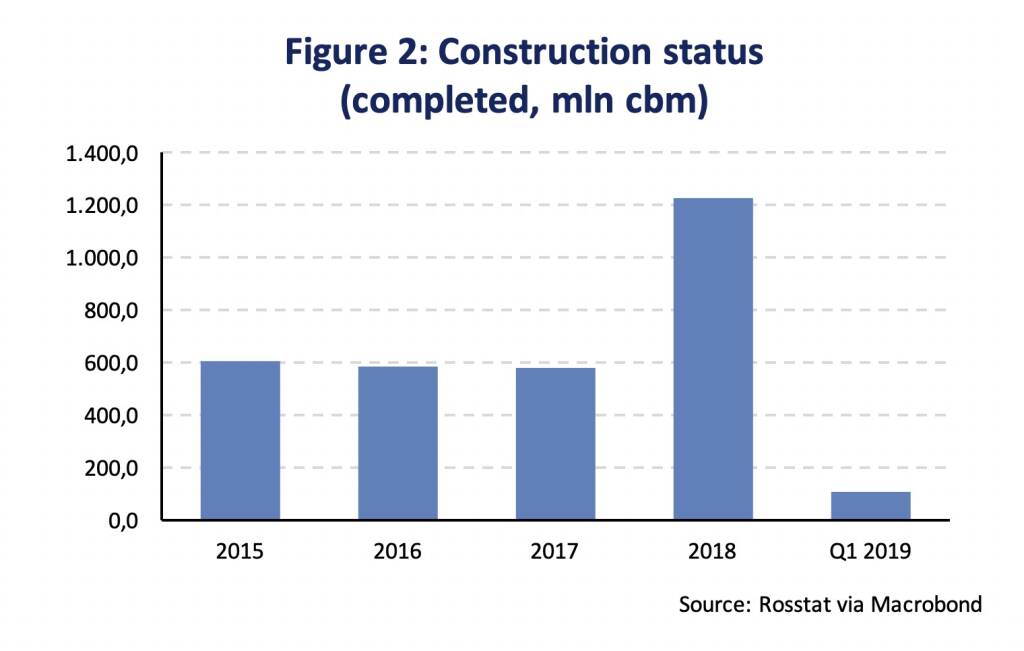
   There were no expenditure details released yet by the Russian statistics office (Rosstat). By year-end 2018, national accounts data showed a surprising pick-up compared to previous quarters [1]. A reason which we detected for volatile growth data is construction activity (Figure 2). The volume of completed construction projects increased significantly during 2018, however, it returned to a more normal level in Q1 2019 (104 mln cubic meters or -1.5 % compared to Q1 2018). Major investment projects – including the Yamal natural gas plant – are being developed by the government. In Q4, construction contributed 0.4 %-age points to growth in gross value added (GVA) being the largest growth contribution after mining & quarrying (0.7 %-age points). Major projects with state participation include the construction of North Stream 2 and Power of Siberia gas pipelines in the Tyumen region, the railway section of the Crimea Bridge and the reconstruction of the Baikal-Amur mainline. 

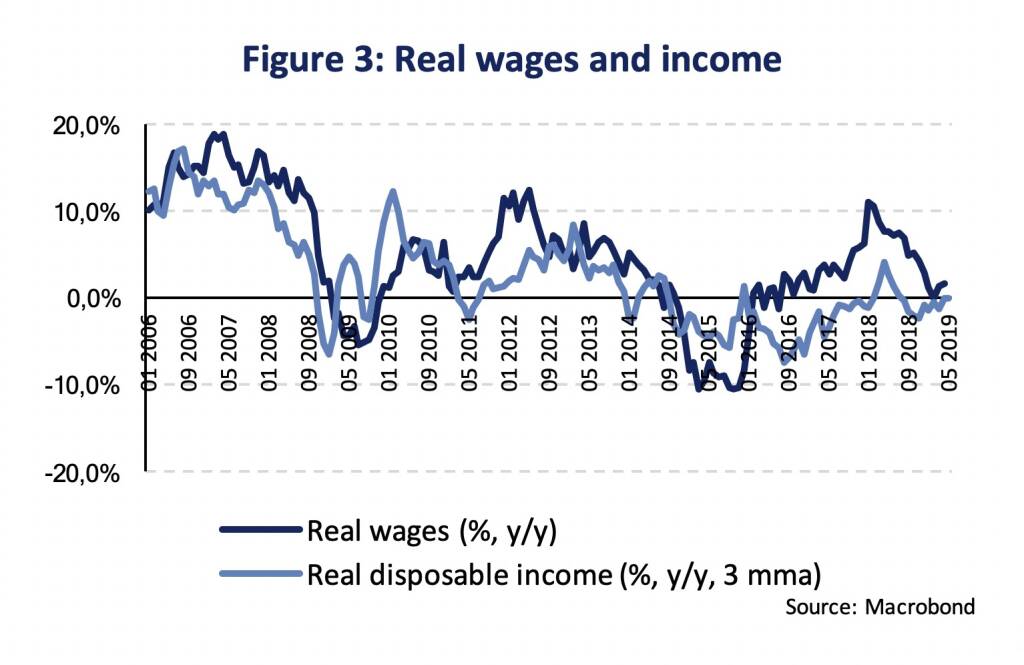
Household consumption has recently been a growth driver. Lending underpins consumption but slowing wage growth constrains a further rise in private demand (Figure 3). Lending to households has further accelerated rising by 23.4 % (y/y) in April. Total loans to corporates increased by 10.9 % in the same month. Since 2016, real wages had picked up after public wage hikes and coinciding with slowing inflation. However, in April, real wages enhanced by meagre 1.6 % after average increases by 7.0 % during last year. Slowing consumer demand is also indicated by weak growth in retail sales (averaging plus 1.6 % during the 3 months until April) and a decline in vehicle sales (-2.5 % over the last 3 months). 

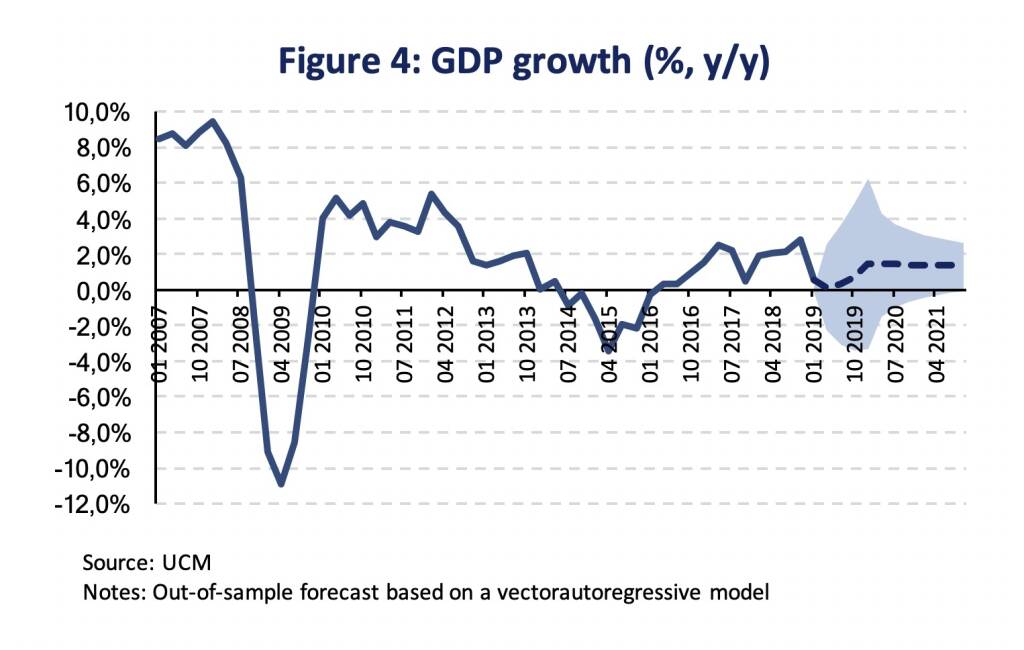
Technically, low Q1 GDP growth leads to downward revisions for growth expectations for the total of the year. In the absence of exogenous shocks (f. ex. rising oil prices), the pace of economic growth will likely revert to its potential growth rate (~1.5 %), though national investment projects – based on successful implementation –   are an upside chance for the economy (Figure 4). 

On Friday, the Central Bank of Russia (CBR) lowered the key interest rate from 7.75 to 7.50 %. The decision was well anticipated and prepared as the CBR mentioned the possibility to cut the key rate in the previous meeting. 

  In its March projection, the CBR forecast GDP growth of 1.2-1.7 % for 2019 and a growth acceleration afterwards (2020: 1.8-2.3 %, 2021: 2.0-3.0 %). The acceleration is expected to come from planned fiscal measures and national projects once successfully implemented [2]. The inflation rate peaked in March (5.3 %) and fell to 5.1 % in May (Figure 5). 

The contribution of food & beverage prices to overall inflation has risen to 2.4 % from an average of 0.6 % in 2018. Furthermore, contributions from non-food (1.3 %) and services prices (1.4 %) gradually rose compared to 2018 (1.2 % respectively 1.1 %). The CBR’s inflation forecast was already revised from 5.0-5.5 % to 4.7-5-2 % in March amid lower than expected pass-through from the VAT rate hike and ruble’s strengthening. The quarterly inflation rate will slow to the central banks’ inflation target of 4 % in H2 2019. Weak growth, declining inflation and inflation expectations as well as external stability pave way for the CBR to lower the interest rate. On last Friday, the CBR further lowered its inflation forecast to 4.2-4.7 % for this year. Going forward, the CBR expects the inflation rate to stay close to its inflation target at 4 %. In addition, the central bank decreased its GDP growth projection to 1.0-1.5 % for 2019. If the situation develops in line with the forecast, the CBR admits “the possibility of a further key rate reduction at one of the upcoming board meetings and a transition to neutral monetary policy until mid-2020”. 

The anticipated transition to a neutral level of the key interest is in line with our expectation. The key policy rate would reach a level around 7 %. Deducting expected inflation rate (around 4 % for 2020), the CBR gave an indication that it sees the real neutral rate of interest around 3 %. While estimates for real (inflation-adjusted) neutral rates of interest are vast for developed economies, they are scarce and conceptually more demanding for emerging markets like Russia. A recent estimate suggested a real neutral interest of 4 % for Russia [3].

The Russian economy continues to expand albeit growth of GDP will remain behind recent expectations after a weak first quarter. Our baseline expectation remains that the economy continues to expand around its potential growth rate, however, the completion of national investment projects offers some upside. As the inflation rate as well as inflation expectations have been declining, the central bank cut the key interest rate and anticipates continuing with a key rate cutting cycle until mid of 2020. 

[1] See UNIQA Capital Markets Weekly as of 1st April 2019: https://press-uniqagroup.com/news-uniqa-capital-markets-weekly?id=81974&menueid=1684&l=deutsch

[2] Central Bank of Russia (2019): Monetary Policy Report, No. 1, March 2019

[3] Grafe, C., Grut, S. and L. Rigon (2018): „Neutral Interest Rates in CEEMEA – Moving in Tandem with Global Factors“, Russian Journal of Money and Finance, March 2018, p. 6-25

Authors

Martin Ertl Franz Xaver Zobl

Chief Economist Economist

UNIQA Capital Markets GmbH UNIQA Capital Markets GmbH


(21.06.2019)

BSN Podcasts
Christian Drastil: Wiener Börse Plausch

Börsepeople im Podcast S24/22: Judith Pap


Bildnachweis

1. GDP growth

2. Construction status

3. Real wages and income

4. GDP growth

5. Inflation

6. Interest rates

Aktien auf dem Radar:AT&S, UBM, Strabag, Zumtobel, Lenzing, Agrana, Uniqa, Wolford, RBI, OMV, Porr, Palfinger, Fabasoft, Rosgix, Erste Group, Kapsch TrafficCom, Polytec Group, Wiener Privatbank, Warimpex, Frauenthal, BKS Bank Stamm, Oberbank AG Stamm, Amag, CA Immo, EuroTeleSites AG, CPI Europe AG, Österreichische Post, Semperit, Telekom Austria, Deutsche Post, Caterpillar.


Random Partner

Novomatic
Der Novomatic AG-Konzern ist als Produzent und Betreiber einer der größten Gaming-Technologiekonzerne der Welt und beschäftigt mehr als 21.000 Mitarbeiter. Der Konzern verfügt über Standorte in mehr als 45 Ländern und exportiert innovatives Glücksspielequipment, Systemlösungen, Lotteriesystemlösungen und Dienstleistungen in mehr als 90 Staaten.

>> Besuchen Sie 55 weitere Partner auf boerse-social.com/partner

Construction status


Real wages and income


GDP growth


Inflation


Interest rates


 Latest Blogs

» Börsepeople im Podcast S24/22: Judith Pap

» Börse-Inputs auf Spotify zu Robert Kleedorfer, Rüdiger Landgraf

» Börse-Inputs auf Spotify zu u.a. Deutsche Telekom, Polytec, Therese Fran...

» Börsepeople im Podcast S24/21: Hugo Brock

» Österreich-Depots: Ultimo April-Bilanz (Depot Kommentar)

» Börsegeschichte 30.4.: MAI, S Immo (Börse Geschichte) (BörseGeschichte)

» Nachlese: Robert Halver (audio cd.at)

» PIR-News: Zahlen von Polytec und Erste Group, Research zu Post und Asta ...

» ATX zum Ultimo zunächst schwächer– Polytec setzt sich Ziel für die Aktie...

» Wiener Börse Party #1146: ATX zum Ultimo zunächst leichter, Polytec top ...


Useletter

Die Useletter "Morning Xpresso" und "Evening Xtrakt" heben sich deutlich von den gängigen Newslettern ab. Beispiele ansehen bzw. kostenfrei anmelden. Wichtige Börse-Infos garantiert.

Newsletter abonnieren

Runplugged

Infos über neue Financial Literacy Audio Files für die Runplugged App
(kostenfrei downloaden über http://runplugged.com/spreadit)

per Newsletter erhalten


Ausgewählte Jobs von PIR-Partnern


Meistgelesen
>> mehr


PIR-Zeichnungsprodukte
Newsflow
>> mehr

Börse Social Club Board
>> mehr
    Star der Stunde: AT&S 3.09%, Rutsch der Stunde: Mayr-Melnhof -1.69%
    wikifolio-Trades Austro-Aktien 9-10: AT&S(6), Strabag(2), CPI Europe AG(2), OMV(1)
    Star der Stunde: Austriacard Holdings AG 3.51%, Rutsch der Stunde: Bajaj Mobility AG -1.35%
    wikifolio-Trades Austro-Aktien 8-9: Lenzing(1), SBO(1), Andritz(1), EVN(1), Palfinger(1)
    BSN Vola-Event Deutsche Post
    #gabb #2092

    Featured Partner Video

    Wiener Börse Party #1140: ATX leicht schwächer, AT&S im Mix mit Glas, LPKF Laser & Börse Online gesucht und die Lärmverschmutzung nervt

    Die Wiener Börse Party ist ein Podcastprojekt für Audio-CD.at von Christian Drastil Comm.. Unter dem Motto „Market & Me“ berichtet Christian Drastil über das Tagesgeschehen an der Wiener Börse. Inh...

    Books josefchladek.com

    L'électrification de la ligne Paris Le Mans (photos by Roger Schall)

    1937
    Editions Perceval

    Daido Moriyama
    Japan, A Photo Theater (English Version
    2018
    Getsuyosha, bookshop M

    Daido Moriyama
    A Hunter (English Version
    2019
    Getsuyosha, bookshop M

    Richard Avedon
    Nothing Personal
    1964
    Atheneum Publishers

    Mark Mahaney
    Polar Night
    2019/2021
    Trespasser


    21.06.2019, 5915 Zeichen
    •  After a growth bounce in Q4 2018, GDP growth returned to more moderate level in 2019.
    • Weak growth and declining inflation pave way for the central bank to accommodate monetary policy. 

      Economic growth slowed during the first quarter after a temporary spike in Q4 2018. In Q1 2019 real gross domestic product (GDP) increased moderately by 0.5 % compared to Q1 2018 and following 2.7 % GDP growth during the end-quarter 2018 (Figure 1). In seasonally adjusted terms, we calculate a drop by 0.4 % of GDP compared to the previous quarter.

       There were no expenditure details released yet by the Russian statistics office (Rosstat). By year-end 2018, national accounts data showed a surprising pick-up compared to previous quarters [1]. A reason which we detected for volatile growth data is construction activity (Figure 2). The volume of completed construction projects increased significantly during 2018, however, it returned to a more normal level in Q1 2019 (104 mln cubic meters or -1.5 % compared to Q1 2018). Major investment projects – including the Yamal natural gas plant – are being developed by the government. In Q4, construction contributed 0.4 %-age points to growth in gross value added (GVA) being the largest growth contribution after mining & quarrying (0.7 %-age points). Major projects with state participation include the construction of North Stream 2 and Power of Siberia gas pipelines in the Tyumen region, the railway section of the Crimea Bridge and the reconstruction of the Baikal-Amur mainline. 

    Household consumption has recently been a growth driver. Lending underpins consumption but slowing wage growth constrains a further rise in private demand (Figure 3). Lending to households has further accelerated rising by 23.4 % (y/y) in April. Total loans to corporates increased by 10.9 % in the same month. Since 2016, real wages had picked up after public wage hikes and coinciding with slowing inflation. However, in April, real wages enhanced by meagre 1.6 % after average increases by 7.0 % during last year. Slowing consumer demand is also indicated by weak growth in retail sales (averaging plus 1.6 % during the 3 months until April) and a decline in vehicle sales (-2.5 % over the last 3 months). 

    Technically, low Q1 GDP growth leads to downward revisions for growth expectations for the total of the year. In the absence of exogenous shocks (f. ex. rising oil prices), the pace of economic growth will likely revert to its potential growth rate (~1.5 %), though national investment projects – based on successful implementation –   are an upside chance for the economy (Figure 4). 

    On Friday, the Central Bank of Russia (CBR) lowered the key interest rate from 7.75 to 7.50 %. The decision was well anticipated and prepared as the CBR mentioned the possibility to cut the key rate in the previous meeting. 

      In its March projection, the CBR forecast GDP growth of 1.2-1.7 % for 2019 and a growth acceleration afterwards (2020: 1.8-2.3 %, 2021: 2.0-3.0 %). The acceleration is expected to come from planned fiscal measures and national projects once successfully implemented [2]. The inflation rate peaked in March (5.3 %) and fell to 5.1 % in May (Figure 5). 

    The contribution of food & beverage prices to overall inflation has risen to 2.4 % from an average of 0.6 % in 2018. Furthermore, contributions from non-food (1.3 %) and services prices (1.4 %) gradually rose compared to 2018 (1.2 % respectively 1.1 %). The CBR’s inflation forecast was already revised from 5.0-5.5 % to 4.7-5-2 % in March amid lower than expected pass-through from the VAT rate hike and ruble’s strengthening. The quarterly inflation rate will slow to the central banks’ inflation target of 4 % in H2 2019. Weak growth, declining inflation and inflation expectations as well as external stability pave way for the CBR to lower the interest rate. On last Friday, the CBR further lowered its inflation forecast to 4.2-4.7 % for this year. Going forward, the CBR expects the inflation rate to stay close to its inflation target at 4 %. In addition, the central bank decreased its GDP growth projection to 1.0-1.5 % for 2019. If the situation develops in line with the forecast, the CBR admits “the possibility of a further key rate reduction at one of the upcoming board meetings and a transition to neutral monetary policy until mid-2020”. 

    The anticipated transition to a neutral level of the key interest is in line with our expectation. The key policy rate would reach a level around 7 %. Deducting expected inflation rate (around 4 % for 2020), the CBR gave an indication that it sees the real neutral rate of interest around 3 %. While estimates for real (inflation-adjusted) neutral rates of interest are vast for developed economies, they are scarce and conceptually more demanding for emerging markets like Russia. A recent estimate suggested a real neutral interest of 4 % for Russia [3].

    The Russian economy continues to expand albeit growth of GDP will remain behind recent expectations after a weak first quarter. Our baseline expectation remains that the economy continues to expand around its potential growth rate, however, the completion of national investment projects offers some upside. As the inflation rate as well as inflation expectations have been declining, the central bank cut the key interest rate and anticipates continuing with a key rate cutting cycle until mid of 2020. 

    [1] See UNIQA Capital Markets Weekly as of 1st April 2019: https://press-uniqagroup.com/news-uniqa-capital-markets-weekly?id=81974&menueid=1684&l=deutsch

    [2] Central Bank of Russia (2019): Monetary Policy Report, No. 1, March 2019

    [3] Grafe, C., Grut, S. and L. Rigon (2018): „Neutral Interest Rates in CEEMEA – Moving in Tandem with Global Factors“, Russian Journal of Money and Finance, March 2018, p. 6-25

    Authors

    Martin Ertl Franz Xaver Zobl

    Chief Economist Economist

    UNIQA Capital Markets GmbH UNIQA Capital Markets GmbH


    (21.06.2019)

    BSN Podcasts
    Christian Drastil: Wiener Börse Plausch

    Börsepeople im Podcast S24/22: Judith Pap


    Bildnachweis

    1. GDP growth

    2. Construction status

    3. Real wages and income

    4. GDP growth

    5. Inflation

    6. Interest rates

    Aktien auf dem Radar:AT&S, UBM, Strabag, Zumtobel, Lenzing, Agrana, Uniqa, Wolford, RBI, OMV, Porr, Palfinger, Fabasoft, Rosgix, Erste Group, Kapsch TrafficCom, Polytec Group, Wiener Privatbank, Warimpex, Frauenthal, BKS Bank Stamm, Oberbank AG Stamm, Amag, CA Immo, EuroTeleSites AG, CPI Europe AG, Österreichische Post, Semperit, Telekom Austria, Deutsche Post, Caterpillar.


    Random Partner

    Novomatic
    Der Novomatic AG-Konzern ist als Produzent und Betreiber einer der größten Gaming-Technologiekonzerne der Welt und beschäftigt mehr als 21.000 Mitarbeiter. Der Konzern verfügt über Standorte in mehr als 45 Ländern und exportiert innovatives Glücksspielequipment, Systemlösungen, Lotteriesystemlösungen und Dienstleistungen in mehr als 90 Staaten.

    >> Besuchen Sie 55 weitere Partner auf boerse-social.com/partner

    Construction status


    Real wages and income


    GDP growth


    Inflation


    Interest rates


     Latest Blogs

    » Börsepeople im Podcast S24/22: Judith Pap

    » Börse-Inputs auf Spotify zu Robert Kleedorfer, Rüdiger Landgraf

    » Börse-Inputs auf Spotify zu u.a. Deutsche Telekom, Polytec, Therese Fran...

    » Börsepeople im Podcast S24/21: Hugo Brock

    » Österreich-Depots: Ultimo April-Bilanz (Depot Kommentar)

    » Börsegeschichte 30.4.: MAI, S Immo (Börse Geschichte) (BörseGeschichte)

    » Nachlese: Robert Halver (audio cd.at)

    » PIR-News: Zahlen von Polytec und Erste Group, Research zu Post und Asta ...

    » ATX zum Ultimo zunächst schwächer– Polytec setzt sich Ziel für die Aktie...

    » Wiener Börse Party #1146: ATX zum Ultimo zunächst leichter, Polytec top ...


    Useletter

    Die Useletter "Morning Xpresso" und "Evening Xtrakt" heben sich deutlich von den gängigen Newslettern ab. Beispiele ansehen bzw. kostenfrei anmelden. Wichtige Börse-Infos garantiert.

    Newsletter abonnieren

    Runplugged

    Infos über neue Financial Literacy Audio Files für die Runplugged App
    (kostenfrei downloaden über http://runplugged.com/spreadit)

    per Newsletter erhalten


    Ausgewählte Jobs von PIR-Partnern


    Meistgelesen
    >> mehr


    PIR-Zeichnungsprodukte
    Newsflow
    >> mehr

    Börse Social Club Board
    >> mehr
      Star der Stunde: AT&S 3.09%, Rutsch der Stunde: Mayr-Melnhof -1.69%
      wikifolio-Trades Austro-Aktien 9-10: AT&S(6), Strabag(2), CPI Europe AG(2), OMV(1)
      Star der Stunde: Austriacard Holdings AG 3.51%, Rutsch der Stunde: Bajaj Mobility AG -1.35%
      wikifolio-Trades Austro-Aktien 8-9: Lenzing(1), SBO(1), Andritz(1), EVN(1), Palfinger(1)
      BSN Vola-Event Deutsche Post
      #gabb #2092

      Featured Partner Video

      Wiener Börse Party #1140: ATX leicht schwächer, AT&S im Mix mit Glas, LPKF Laser & Börse Online gesucht und die Lärmverschmutzung nervt

      Die Wiener Börse Party ist ein Podcastprojekt für Audio-CD.at von Christian Drastil Comm.. Unter dem Motto „Market & Me“ berichtet Christian Drastil über das Tagesgeschehen an der Wiener Börse. Inh...

      Books josefchladek.com

      L'électrification de la ligne Paris Le Mans (photos by Roger Schall)

      1937
      Editions Perceval

      Jack Davison
      13–15 November. Portraits: London
      2026
      Helions

      Joan van der Keuken
      Achter Glas
      1957
      C. de Boer jr.

      Mark Mahaney
      Polar Night
      2019/2021
      Trespasser

      Yasuhiro Ishimoto
      Someday Somewhere (Aru hi aru tokoro, 石元泰博 ある日ある所)
      1958
      Geibi Shuppan